
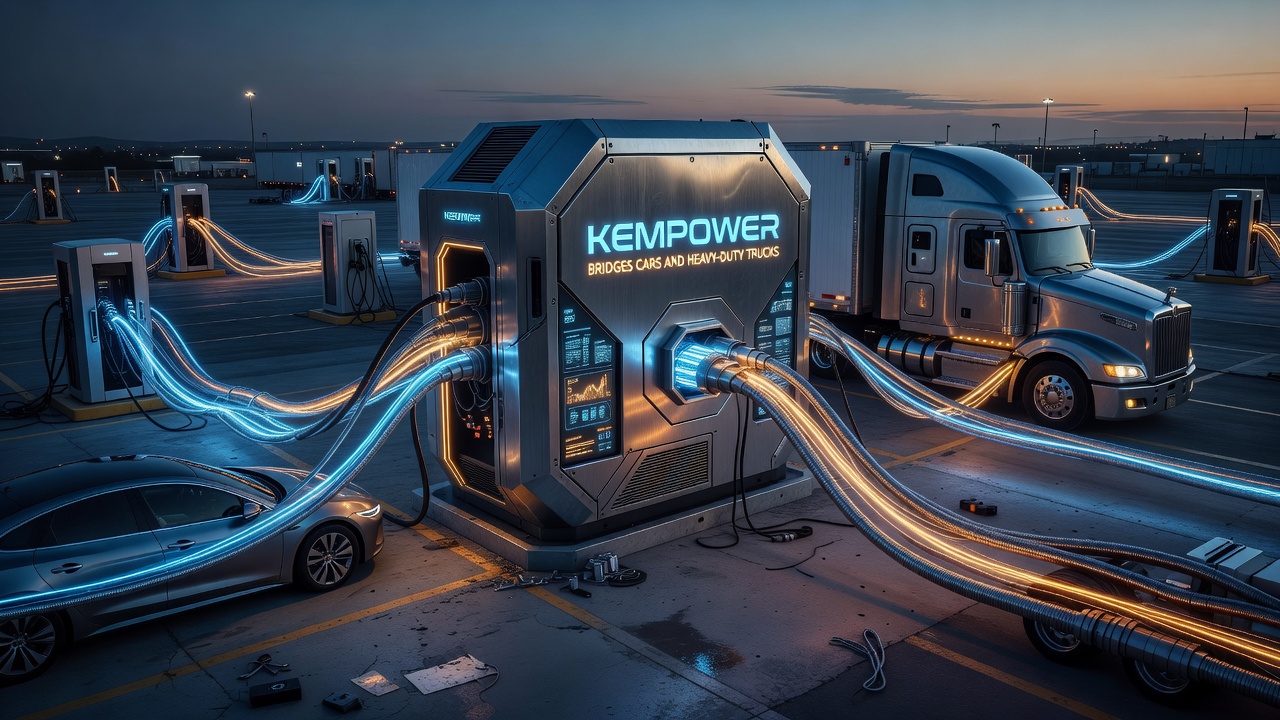
A single piece of hardware that can charge both a passenger sedan and an 18-wheeler is no longer a concept slide - it's a product going on sale next year. Kempower has unveiled the Mega Satellite Flex, a high-power charging dispenser capable of delivering up to 560 kW through the established CCS standard or up to 1.2 MW through the emerging Megawatt Charging System (MCS) built for heavy-duty trucks. The announcement came this week at ACT Expo, during the company's Unplug & Recharge event for customers and partners.
The timing reflects a real fork in the road for charging infrastructure. CCS has been the dominant connector for battery-electric cars for years, but it was never designed to move the enormous energy loads that electric trucks require to stay productive on tight schedules. MCS was developed specifically to close that gap, and its rollout is now picking up speed across North America and Europe. Rather than forcing site operators to choose one standard and gamble on the other, Kempower's approach lets a single dispenser serve both - a question of infrastructure flexibility that echoes debates elsewhere in digital services, where users weigh compatibility and control; anyone curious about how one provider handles it in the networking and privacy space will recognize the same underlying logic of building for more than one use case at once. how one provider handles it
Practically, that flexibility could reshape how charging sites are planned. Building separate stations for cars and trucks means duplicating land, grid connections, and permitting - all expensive and slow. A dispenser that handles both from day one lets a site operator serve mixed traffic immediately, rather than betting on truck volume before adding MCS later, or vice versa. That matters because charging sites are capital-intensive, and utilization rate is the main driver of how quickly an operator recovers its investment.
What the Hardware Actually Delivers
The specifications point to a serious piece of power electronics. The unit supports up to 1,500 amps on the MCS side and 700 amps for CCS, with cable lengths of 5 meters for CCS and 2.7 meters for MCS - long enough to reach truck inlets without forcing awkward parking maneuvers. It's also built to take advantage of 800-volt vehicle architectures, an area where newer electric cars and trucks are increasingly capable of accepting faster charging than older 400-volt platforms allow. An optional integrated payment terminal rounds out the package for public-facing deployments.
Fitting Into Existing Networks
Kempower says the Mega Satellite Flex works within its existing distributed charging architecture, meaning operators who already run Kempower systems won't need to rebuild their power cabinets or site wiring to add the new dispenser. That compatibility matters commercially: infrastructure operators are wary of stranded investment, and a modular add-on is a lower-risk proposition than a parallel system.
Why the MCS Transition Matters
Megawatt charging is still young, and standards, vehicle availability, and site permitting are all evolving together rather than in sequence. Dispensers that support both CCS and MCS act as a hedge during this uncertain period, letting operators serve today's vehicles while preparing for tomorrow's. The Mega Satellite Flex is expected to reach North America and Europe in July 2026, a timeline that gives truck manufacturers and fleet operators a firm date to plan around as MCS-equipped vehicles reach the road in greater numbers.